
Over the last weeks I have been checking in with four product/account teams at work. Each time we discussed the challenge in rising amount of work items: tickets, test automation, test cases. Behind the concerns was a quest to make delivery sustainable both for the quality of the solution and for the people doing the work. Like the tetrapods in the picture, we need to break the waves without corroding our foundation and making it the easiest solution to follow the preferred path .
The true value of improving the “QE Ways of working” is the second order effects: Faster time to market, faster quality engineering practices and better quality, as quality is being built in correctly from the start. The guru trick is really that investing in knowledge sharing, less siloes and better psychological safety pays off – even in the short run. Readers of The DevOps Handbook can recognize this as the chronic conflict of pursuing both: responding to the rapidly changing competitive landscape for features and platforms while maintaining business as usual.
The challenges of IT organizations today are systemic and organizational issues that cannot be solved within Quality engineering alone. If we fiddle in one end of the delivery model, it just causes bottlenecks elsewhere. To me it the team challenges looks exactly like what is covered under Developer Relations (DevRel) and Developer Experience (DX) and Internal development Platform (IDP). Similar terms could exist for quality engineering too:
- QE-E: Quality Engineering Experience: how easy is to produce tests, faster feedback, less friction,
- QE-R: Quality Engineering Relationship: help QE people connect, use shared platforms and make work visible
- EQ-P: Quality Engineering Platform: collection of tools, knowledge bases and best practices
Hiding underneath is the evergreen challenge of providing a “golden path” that is easy to follow and get’s the job done. Getting the job done includes that things have been tested for all the relevant things (functions, integrations, service targets, compliance…). This goes for both developers and quality engineering people. Great quality engineering is so much more than “good old testing”. Experience and relationship work can start with asking questions like:
- Can I easily get accesses to repro’s, knowhow and models?
- Is it clear how to make a PR?
- Are the expectations around DoR and DoD up to date and relevant?
- Are the pipelines and builds always broken?
- Do we even have barriers and skill files for the AI testing happening?
- Does our gates include DAST, SAST, SBOM etc
- is there test data around and what is good practice
Coming back to the tetrapod analogy, here’s a random page in “internal development platform golden paths“:
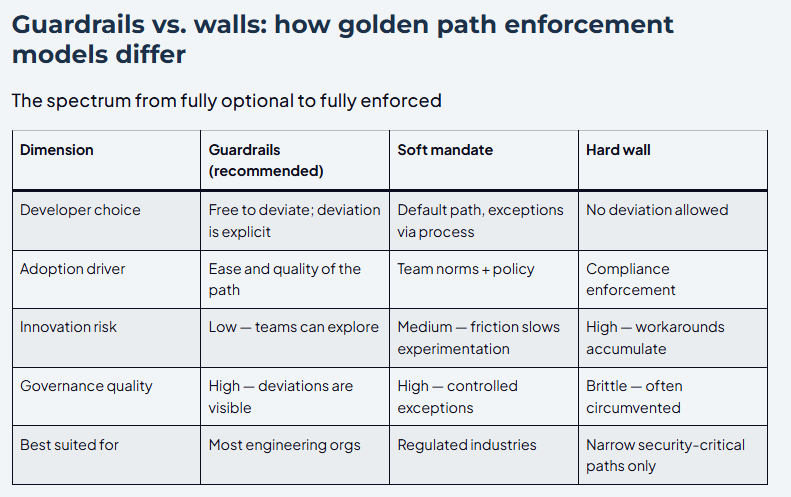
The golden path can look different depending on the terrain. Some of the artefacts I would prefer to work with would be: when to be part of the team, when to coach and when to provide an end-point. There is a huge difference in saying I’m digging into this, I’m collaborating with others to do this and others know how to do this. Or in the framing of Team Topologies, where are you with the stream, enabling the stream or providing an internal platform? Som examples for QE Experience and relations work would be provide solutions like:
- here’s the team templates for DoD and DoR (in the team)
- let’s add a security engineer to the team, I can see the controls require work (in team)
- here’s the repository of relevant skill files for application security (an end-point)
- what if I facilitate to update the test strategy (coach)
- I know someone that can help you scale wrt service level testing (coach)
It’s all about taking time to be deliberate on the quality practices. Each quality practice will have an accountable, and other participants (QACI). But also, each practice will be in an evolution state: some are being explored, some are being codified others have reached peak best practice. When you recognize the pattern you’re OK. It’s when you start evaluating your practices you can learn how to make it the easiest to do things the right way first.